Public Transport · IoT
Electric Bus IoT & Payment System
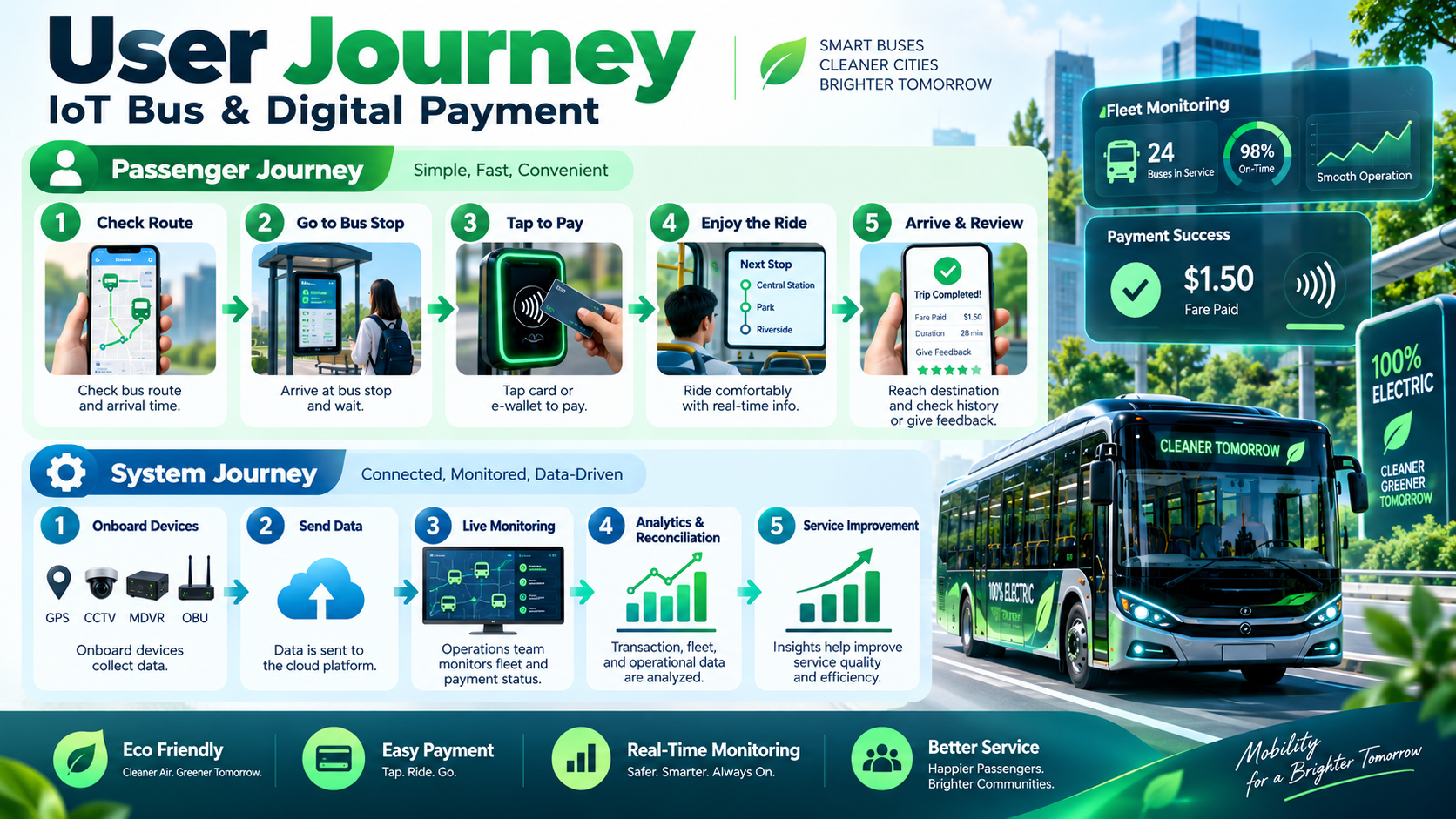
The IoT Bus & Payment TOB Project focuses on managing and optimizing the technologies that support the operations of the Medan City Electric Bus service. The IoT implementation includes integrated monitoring of various onboard devices and systems, such as GPS, MDVR, CCTV, OBU, network connectivity, and other supporting equipment. This enables real-time visibility into fleet and device conditions, supporting day-to-day operations, improving system reliability, and facilitating faster issue identification and resolution in the field.
- Role
- Payment - Reconsiliation - IOT - Monitoring
- Category
- Public Transport · IoT
- Period
- 2026 — Present
Project narrative
Description
Project Overview
The IoT Bus & Payment TOB Project focuses on the management, monitoring, and optimization of the technology ecosystem used in electric bus operations.
The system integrates onboard IoT devices, vehicle connectivity, passenger payment systems, and monitoring platforms to provide more unified and actionable operational information.
The implementation covers various components, including GPS, MDVR, CCTV, OBU, display/media systems, cellular connectivity, and other supporting devices.
Each component has different functions and data sources, making system integration, continuous monitoring, and structured issue-handling mechanisms essential to ensure that the overall ecosystem operates consistently and reliably.
Data Integration & Online Reconciliation
One of the key developments within this ecosystem is the integration of multiple operational data sources into an Online Reconciliation process.
Data from the Payment TOB system can be compared and analyzed alongside information such as kilometers traveled, trip cycles, corridors, fleet data, operational targets, and other relevant data sources.
This approach transforms reconciliation activities that previously relied heavily on manual verification into a more structured, automated, and traceable process.
For example, the system can help analyze the relationship between:
Bus & Corridor → Trip Cycle → Kilometer → Passenger → Transaction → Revenue → Reconciliation
With this approach, discrepancies and anomalies between operational data and transaction records can be identified, analyzed, and traced more efficiently.
Roles & Responsibilities
In this project, my responsibilities sit at the intersection of technology, operations, vendors, and business requirements.
My activities include monitoring the implementation of IoT and Payment TOB systems, analyzing device and data issues, coordinating troubleshooting activities with vendors and field teams, validating corrective actions, and ensuring that operational requirements are translated into meaningful system improvements.
In addition to day-to-day operational activities, I am also involved in defining and developing system requirements such as:
Monitoring Dashboards • Online Reconciliation • Data Mapping • Business Rules • Product Backlog • Acceptance Criteria • Project Timelines • Development & Testing Coordination
This allows both operational and technical requirements to remain aligned throughout the project lifecycle.
Working Approach
The working approach follows the cycle:
Identify → Analyze → Coordinate → Resolve → Validate → Monitor
This ensures that issue resolution does not stop at fixing the device itself. The process also includes validating whether the resulting data is correctly generated, transmitted, and reflected in the system after implementation.
By applying this cycle, operational issues can be handled in a more structured manner while reducing the risk of recurring problems.
Project Value
This project demonstrates the practical application of IoT, payment technology, system integration, operational monitoring, and project management within a real-world public transportation environment.
The project places a strong focus on improving device reliability, data accuracy, monitoring efficiency, operational visibility, and overall service quality.
By integrating IoT devices, payment systems, operational data, and monitoring platforms into a connected ecosystem, the project helps support more reliable operations, faster issue resolution, and better data-driven decision-making.