FinTech • Anti Money Laundering • Risk Management • Compliance Technology • PPATK Report • SWIFT
AML & Risk Management System
The Anti-Money Laundering (AML) & Risk Management System is an integrated platform designed to help financial institutions perform transaction monitoring, suspicious activity identification, customer risk assessment, alert management, investigation, and risk reporting in a more structured manner. The system combines transaction data with customer profiles to help compliance and risk teams detect potential anomalies more quickly, manage follow-up actions based on risk levels, and maintain a clear process trail for audit and evaluation purposes.
- Role
- IT Project Manager — Managing End-to-End Delivery of AML Monitoring, Risk Assessment, Investigation & Compliance Platform
- Category
- FinTech • Anti Money Laundering • Risk Management • Compliance Technology • PPATK Report • SWIFT
- Period
- 2023 - 2024
Project narrative
Description
AML Transaction Monitoring
The AML & Risk Management System project focuses on building a platform that helps organizations monitor financial activities and risks in a more integrated manner. The system is designed so that various types of information such as customer profiles, transaction history, risk parameters, alerts, case investigations, and reporting can be managed through a single platform.
The system can help monitor patterns such as:
- unusually high-value transactions,
- sudden increases in transaction frequency,
- transaction activities that do not match the customer profile,
- repeated transactions following specific patterns,
- relationships between accounts or related parties,
- and other risk parameters based on internal policies.
Customer Risk Assessment
In addition to transaction monitoring, the system also supports the Customer Risk Assessment process to help determine risk levels based on customer profiles and characteristics.
Some of the parameters may include:
Customer Profile → Business Type → Transaction Behavior → Geographic Risk → Historical Activity → Risk Score
The assessment results can then be classified into categories such as:
Low Risk • Medium Risk • High Risk
The risk score can be used as one of the key references for determining monitoring intensity, additional verification requirements, and escalation processes.
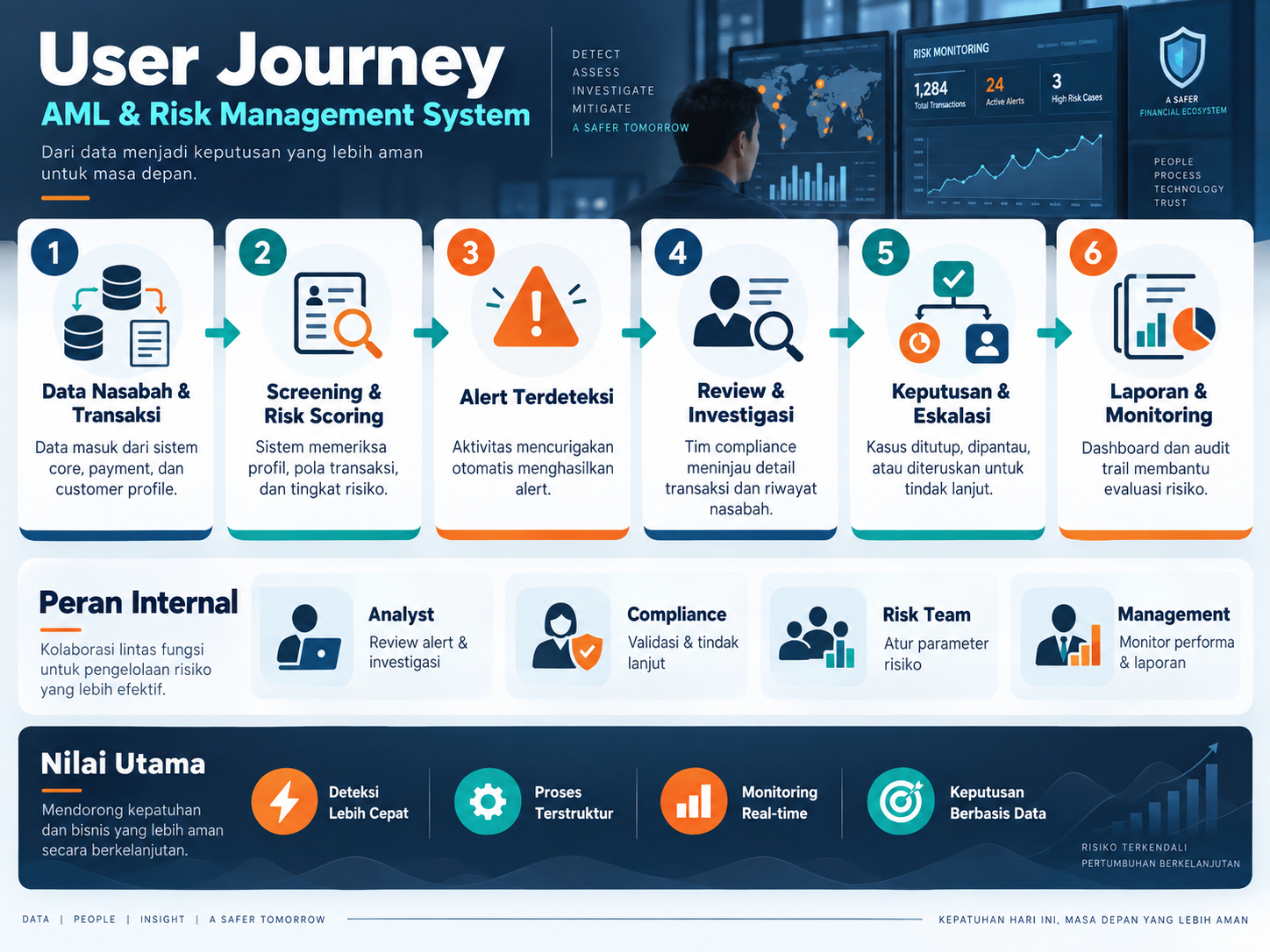
Data Integration
An AML system requires integration with multiple data sources to enable more comprehensive analysis.
Data sources may include:
Core Transaction System → Customer Database → Payment System → External Data Source → AML Platform
The data is then processed to generate customer profiles, transaction monitoring, risk scoring, alerts, and reporting.
As an IT Project Manager, one of my key priorities at this stage is to ensure that data mapping, API integration, data consistency, security, and error handling are clearly defined before development begins.
Delivery Process
Project delivery is carried out progressively using an Agile / iterative development approach.
The delivery process includes:
Requirement Analysis → Solution Design → Sprint Planning → Development → Integration Testing → QA → UAT → Deployment → Post-Implementation Monitoring
During each Sprint, development progress is monitored together with the team to ensure that features remain aligned with the requirements and do not create dependencies that could block other modules.
Issues, risks, and change requests are documented and analyzed based on their impact on scope, timeline, cost, and quality.
Project Value & Impact
The implementation of the AML & Risk Management System helps organizations strengthen their capabilities in risk detection, transaction monitoring, investigation management, and compliance process support.